Showing posts with label Insect Poems. Show all posts

Saturday, 31 August 2024

A Song Dynasty Poem about the Asiatic Dayflower

《詠碧蟬花》 楊巽齋
揚葩簌簌傍疏籬, 薄翅舒青勢欲飛。
幾誤佳人將扇撲, 始知錯認枉心機
‘Ode to the Green Cicada Flower’
Yang Xunzhai (Song Dynasty)
The flower flutters softly by the feeble hedge,
Its raw-green wings spread out, ready for flight,
The beautiful woman attempts to swat it with her fan
Before she realizes her mistake, her effort wasted.
My translation.

Monday, 5 August 2024

Small Pond

《小池》 楊萬里

泉眼無聲惜細流,
樹陰照水愛晴柔。
小荷才露尖尖角,
早有蜻蜓立上頭。
‘Small Pond’
Yang Wanli (1127-1206)
Springs quietly and sparingly trickle out.
Tree shades dangle on water white and soft.
No sooner had the young lotus shot sprouts
Than the dragonflies alighted on their tops.
Translated by Qin Dachuan.

Dragonfly on a Lotus Bud in Changsha

Monday, 22 July 2024

The Silkworm and the Spider

Tomás de Iriarte (1750-1791)
‘El gusano de seda y la araña’

Trabajando un Gusano su capullo,
La Araña, que texía á toda prisa,
De esta suerte le habló con falsa risa
Mui propia de su orgullo:
¿Qué dice de mi tela el seor Gusano?
Esta mañana la empecé temprano,
Y ya estará acabada á mediodía.
Mire qué sutil es, mire qué bella....
El Gusano con sorna respondía:
Usted tiene razon: así sale ella.

‘The Silkworm and the Spider’
While a Worm was working on his cocoon,
The Spider, who was weaving fast,
Spoke to him in mock jest,
What does Mr. Worm have to say about my web?
I started early this morning
And it will be finished by noon.
See how delicate it is, behold how beautiful....
The Worm replied sarcastically:
You are right: that is how it comes out.
Tomas de Iriarte, Fabulas literarias, ed. by Jaime Fitzmaurice-Kelly (Oxford: OUP, 1917; 1782), p. 5. My translation.

Monday, 15 July 2024

A Whole Life

Joachim Ringelnatz
'Ein ganzes Leben'

»Weißt du noch«, so frug die Eintagsfliege
Abends, »wie ich auf der Stiege
Damals dir den Käsekrümel stahl?«

Mit der Abgeklärtheit eines Greises
Sprach der Fliegenmann: »Gewiß, ich weiß es!«
Und er lächelte: »Es war einmal —«

»Weißt Du noch«, so fragte weiter sie,
»Wie ich damals unterm sechsten Knie
Jene schwere Blutvergiftung hatte?« —

»Leider«, sagte halb verträumt der Gatte.

»Weißt du noch, wie ich, weil ich dir grollte,
Fliegenleim-Selbstmord verüben wollte?? —
Und wie ich das erste Ei gebar?? —
Weißt du noch, wie es halb sechs Uhr war?? —
Und wie ich in die Milch gefallen bin?? — —

Fliegenmann gab keine Antwort mehr,
Summte leise, müde vor sich hin:
»Lang, lang ist’s her — — lang — — —«

'A whole Life'

In the evening, the Mayfly asked:
“Do you remember how I stole from you
That cheese crumb on the stairs?

With the detachment of an old man,
Her Husband-fly said, “Indeed, I remember!”
And he smiled, “That was a long time now —”

“Do you remember”, she asked
”How under my sixth knee
I had that severe blood poisoning?” —

“Unfortunately,” said her husband half in a dream.

“Do you remember, how, because I resented you,
I wanted to kill myself upon the the flypaper?? —
And how I gave birth to the first egg?? —
Do you remember, when it was half past five?? —
And how I fell into the milk?? — —

The Fly-husband answered her no more,
Humming softly, languidly to himself"
“It's been a long, long time — — long — — —”
Joachim Ringelnatz, Die Gedichte, ed. by Fritz & Katinka Eycken with Jabob Winter (Berlin: Haffmans Verlag bei Zweitausendeins, 2009), pp. 662-63 [1933]. My translation.

Sunday, 14 July 2024

Long-awaited Summer

Aestas ab exilio
redit exoptata,
picto ridet gremio
tellus purpurata.
Miti cum susurrio
suo domicilio
gryllus delectatur.
Hoc canore iubilo,
multiformi sibilo
nemus gloriatur.

Long-awaited summer has come from exile, the violaceous earth smiles in her painted lap. The cricket, in his home, amuses himself with a soothing whisper. With this melodious song, with this multi-voiced hissing, the forest rejoices.
Carmina Burana 74.31-40. My translation.

Friday, 12 July 2024

The Moth

Walter de la Mare  
'The Moth'

Isled in the midnight air,
Musked with the dark's faint bloom,
Out into glooming and secret haunts
The flame cries, 'Come!'

Lovely in dye and fan,
A-tremble in shimmering grace,
A moth from her winter swoon
Uplifts her face:

Stares from her glamorous eyes;
Wafts her on plumes like mist;
In ecstasy swirls and sways
To her strange tryst.

Thursday, 11 July 2024

The Ant

'The Ant'
Ogden Nash

The ant has made herself illustrious
By constant industry industrious.
So what? Would you be calm and placid
If you were full of formic acid?

Friday, 7 June 2024

Summer Cicadas

‘Summer’
Lawrence Durrell

The little gold cigale
Is summer’s second god, the lovers know it,
His parched reverberating voice
Deepens the gold thirst of the noons
And follows the black sun’s long
Fig-ripening and vine-mellowing fall
So leisurely from heaven’s golden car
Day by successive day to end it all . . .

And where the Latin heat has stretched
The skin of valleys will his voice
Rubbing and scraping at the lover’s ear
Oracles of past suns recall,
Prodigals of leisure and brown skins,
Wine mixed with kisses and the old
Dreamless summer sleeps they once enjoyed
In Adam’s Eden long before the Fall.
Lawrence Durrell, Collected Poems (London: Faber and Faber, 1960), p. 191.

Monday, 18 March 2024

Ohrwurm

Wilhelm Busch, Balduin Bählamm, der verhinderte Dichter (Munich: Verlag von fr. Bassermann, 1883), pp. 36-39:

In freier Luft, in frischem Grün,
Da, wo die bunten Blümlein blühn,
In Wiesen, Wäldern, auf der Heide,
Entfernt von jedem Wohngebäude,
Auf rein botanischem Gebiet,
Weilt jeder gern, der voll Gemüt.
Hier legt sich Bählamm auf den Rücken
Und fühlt es tief und mit Entzücken,
Nachdem er Bein und Blick erhoben:
Groß ist die Welt, besonders oben!
Wie klein dagegen und beschränkt
Zeigt sich der Ohrwurm, wenn er denkt.
Engherzig schleicht er durch das Moos,
Beseelt von dem Gedanken bloß,
Wo's dunkel sei und eng und hohl,
Denn da nur ist ihm pudelwohl.
Grad wie er wünscht und sehr gelegen
Blinkt ihm des Dichters Ohr entgegen.
In diesen wohlerwärmten Räumen,
So denkt er, kann ich selig träumen.
Doch wenn er glaubt, daß ihm hienieden
Noch weitre Wirksamkeit beschieden,
So irrt er sich. – Ein Winkelzug
Von Bählamms Bein, der fest genug,
Zerstört die Form, d.h. so ziemlich,
Die diesem Wurme eigentümlich,
Und seinem Dasein als Subjekt
Ist vorderhand ein Ziel gesteckt.
Sogleich und mit gewisser Schnelle
Vertauscht der Dichter diese Stelle
Für eine andre, mehr erhöht,
Allwo ein Bäumlein winkend steht.
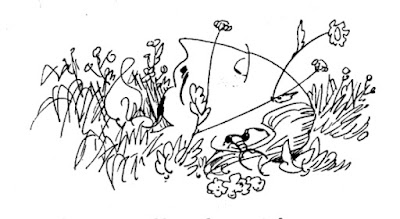
Wilhelm Busch - Ohrworm

In the open air, in fresh green,
Where the colorful florets bloom,
In meadows, forests, on the heathland,
Far away from any residential building,
In a pure botanical territory,
That is where everyone full of spirit likes to stay.
Here Bählamm lies on his back
And feels deeply and with delight,
After raising his leg and eyes:
The world is great, especially above!
How small and limited in comparison
The earwig reveals himself with his thoughts,
Narrow-minded he creeps through the moss,
Inspired by the mere thought of
Some place where it is dark and narrow and hollow,
Because that is the only place he feels at ease.
Just as he wishes and very conveniently
The poet’s ear twinkles at him.
In these well-warmed rooms,
So he thinks, I can dream happily.
But if he believes that he will have
greater efficacy down here, he is mistaken.
– A twist of Bählamm's leg, which is strong enough,
Breaks the form, i.e. more or less,
that is particular to this worm,
and his existence as a subject has an end set forthwith.
Instantly and with a certain speed
The poet swaps this place for another, further elevated
Where a little tree stands waving.
My translation. I attempted a stricter translation in trochaic tetrameter couplets after the original, but was not successful.

Wednesday, 16 August 2023

Wordsworths on Butterflies

Dorothy Wordsworth, The Grasmere Journal (New York: Henry Holt and Company, 1987), pp. 113-14 [Sunday 14 March 1802]:

William had slept badly—he got up at nine o’clock, but before he rose he had finished ‘The Beggar Boys’—and while we were at breakfast that is (for I had breakfasted) he, with his basin of broth before him untouched, and a little plate of bread and butter he wrote the Poem to a Butterfly! He ate not a morsel, nor put on his stockings, but sate with his shirt neck unbuttoned, and his waistcoat open while he did it. The thought first came upon him as we were talking about the pleasure we both always feel at the sight of a butterfly. I told him that I used to chase them a little, but that I was afraid of brushing the dust off their wings, and did not catch them—he told me how they used to kill all the white ones when he went to school because they were Frenchmen. Mr Simpson came in just as he was finishing the poem. After he was gone I wrote it down and the other poems, and I read them all over to him. We then called at Mr Oliff’s. Mr O walked with us to within sight of Rydale—the sun shone very pleasantly, yet it was extremely cold. We dined and then Wm went to bed. I lay upon the fur gown before the fire, but I could not sleep - I lay there a long time. It is now half past five I am going to write letters. I began to write to Mrs Rawson—William rose without having slept - we sate comfortably by the fire till he began to try to alter ‘The Butterfly’, and tired himself—he went to bed tired.
William Wordsworth
‘To a Butterfly’
Stay near me—do not take thy flight!
A little longer stay in sight!
Much converse do I find in thee,
Historian of my infancy!
Float near me; do not yet depart!
Dead times revive in thee:
Thou bring’st, gay creature as thou art!
A solemn image to my heart,
My father's family!

Oh! pleasant, pleasant were the days,
The time, when, in our childish plays,
My sister Emmeline and I
Together chased the butterfly!
A very hunter did I rush
Upon the prey:—with leaps and springs
I followed on from brake to bush;
But she, God love her, feared to brush
The dust from off its wings.