ἰδεῖν μὲν γὰρ ψυχὴν ἔφη τήν ποτε Ὀρφέως γενομένην κύκνου βίον αἱρουμένην, μίσει τοῦ γυναικείου γένους διὰ τὸν ὑπ᾽ ἐκείνων θάνατον οὐκ ἐθέλουσαν ἐν γυναικὶ γεννηθεῖσαν γενέσθαι: ἰδεῖν δὲ τὴν Θαμύρου ἀηδόνος ἑλομένην: ἰδεῖν δὲ καὶ κύκνον μεταβάλλοντα εἰς ἀνθρωπίνου βίου αἵρεσιν, καὶ ἄλλα ζῷα μουσικὰ ὡσαύτως. εἰκοστὴν δὲ λαχοῦσαν ψυχὴν ἑλέσθαι λέοντος βίον: εἶναι δὲ τὴν Αἴαντος τοῦ Τελαμωνίου, φεύγουσαν ἄνθρωπον γενέσθαι, μεμνημένην τῆς τῶν ὅπλων κρίσεως. τὴν δ᾽ ἐπὶ τούτῳ Ἀγαμέμνονος: ἔχθρᾳ δὲ καὶ ταύτην τοῦ ἀνθρωπίνου γένους διὰ τὰ πάθη ἀετοῦ διαλλάξαι βίον.Plato, Rep. X.620a-b [Trans. by Paul Shorey].
He saw the soul that had been Orpheus’, he said, selecting the life of a swan, because from hatred of the tribe of women, owing to his death at their hands, it was unwilling to be conceived and born of a woman. He saw the soul of Thamyras choosing the life of a nightingale; and he saw a swan changing to the choice of the life of man, and similarly other musical animals. The soul that drew the twentieth lot chose the life of a lion; it was the soul of Ajax, the son of Telamon, which, because it remembered the adjudication of the arms of Achilles, was unwilling to become a man. The next, the soul of Agamemnon, likewise from hatred of the human race because of its sufferings, substituted the life of an eagle.
Showing posts with label Birds. Show all posts
Showing posts with label Birds. Show all posts
Monday, 30 December 2024
Reincarnation as Birds
Sunday, 1 December 2024
Gray-capped Pygmy Woodpecker
Gray-capped Pygmy Woodpecker (Yungipicus canicapillus, 星头啄木鸟).
A small woodpecker, spotted in Xuanwu Lake Park in Nanjing during a morning walk (I was there for a conference).

Friday, 29 November 2024
Swan Goose
Swan Goose (Anser cygnoides, 鸿雁).
A migratory goose that winters in southern China, though truly wild ones are rare. More common are domesticated geese and there feral (having escaped from farms) cousins.

Monday, 30 September 2024
Chinese Pond Heron in September
Chinese Pond Heron (Ardeola bacchus, 池鹭).
Throughout the summer one sees these herons in their distinctive breeding plumage: a subdued chestnut-red from head to breast and with white wings under blue plumes. After the end of the breeding season ends,they adorn their winter whites and browns. This heron is one of two such birds, whom I regularly see fishing in Taozi Lake. In previously years, these herons were infrequently present there, and though fish and frog may think otherwise: they are a welcome addition to the scenic lake. Hopefully next Autumn the small lake will host even more fishing birds.

Friday, 13 September 2024
Black Bulbul
Black Bulbul (Hypsipetes leucocephalus, 黑短脚鹎). White headed morph.
I have been infrequently spotting this bird since mid-July on Yuelu Mountain by my college. In fact I have been seeing and hearing birds in greater numbers and variety along my favourite footpaths throughout the mountain this season than I have over the past several years; a trend I hope will continue.

Saturday, 10 August 2024
Yellow-throated Bunting
Yellow-throated Bunting (Emberiza elegans, 黄喉鹀).
Another bunting, I often saw Huxingshan Yao Ethnic Township: every evening they were singing in the trees and on the telephone wires: welcoming the setting sun.

Friday, 9 August 2024
Meadow Bunting
Meadow Bunting (Emberiza cioides, 三道眉草鹀).
I did not have much time for birding, during my time at Huxingshan Yao Ethnic Township, but in my evening walks I could not help but notice the significant numbers of daurian redstarts, and even more bunting, throughout the local farmland.

Thursday, 8 August 2024
Adult Black-crowned Night-heron
Black-crowned night-heron (Nycticorax nycticorax, 夜鹭).
There are many of them now, fishing in the evening, in the lakes and the streams. This one was fishing in the lily pond at Xianjia Lake: there are many other species of bitterns, herons and egrets there too and a flock of myna which swarms into the pond every sunset.

Sunday, 28 July 2024
Mountain Bulbul
Mountain Bulbul (Ixos mcclellandii, 绿翅短脚鹎).
One of a small flock, I spotted one early morning near the base of Yuelu Mountain. In the dry season various songbirds congregate in the few valleys with lingering rivulets or ponds, making now a good time for observing local birds; provided one can tolerate the heat, which is vigorous now, even in the shade.

Saturday, 29 June 2024
Red-rumped Swallow
Red-rumped swallow (Cecropis daurica, 金腰燕).
Since early spring there have been large numbers of them hunting around the river and lakes. There are now fewer and fewer of them about. Last year, at this time, this one was injured his wing flying into a tree by the foot of Yuelu Mountain. I moved it where it would be more protected from people and cats, managed to give it some water and watched it until it went to sleep; sadly nature took its course.

Tuesday, 25 June 2024
Changsha Floods
A White Wagtail (Motacilla alba, 白鹡鸰). We have had steady rain for a couple weeks and expect rain for a few weeks more, but yesterday morning we were inundated with heavy downpour, drastically flooding parts of the city.

This is the season for heavy rain in this part of the world. 100 years ago in 1924, Changsha also experienced severe flooding; I cannot find much about what parts of the city were then affected but there are some (sadly low resolution) photos available from the University of Bristol's online Historical Photographs of China collections.

Image courtesy of George Trobridge Collection, University of Bristol Library (www.hpcbristol.net). C. July 1924.

This is the season for heavy rain in this part of the world. 100 years ago in 1924, Changsha also experienced severe flooding; I cannot find much about what parts of the city were then affected but there are some (sadly low resolution) photos available from the University of Bristol's online Historical Photographs of China collections.

Image courtesy of George Trobridge Collection, University of Bristol Library (www.hpcbristol.net). C. July 1924.
Friday, 21 June 2024
Juvenile Chinese Blackbird
Juvenile Chinese Blackbird (Turdus mandarinus, 乌鸫).
Every summer there are great numbers of juvenile blackbirds around the parks. They are not very shy when they are young and they are invariably ugly, but in a cute way.

Tuesday, 11 June 2024
Juvenile Spotted Dove
Spotted Dove (Spilopelia chinensis, 珠颈斑鸠).
A common scene: a single child growing up in the city.

Monday, 10 June 2024
Fledgling Greater Necklaced Laughingthrush
Juvenile Greater Necklaced Laughingthrush (Pterorhinus pectoralis, 黑领噪鹛).
I rarely see the young ones; this one has been keeping close to its mother and its flock but is slowly growing more bold in its explorations among the trees and bushes of Yuelu Mountain.

Sunday, 9 June 2024
Little Ringed Plover
Little Ringed Plover (Thinornis dubius, 金眶鸻). Juvenile.
Not a rare bird, but not one that is normally found in Changsha! Very briefly it was visible on the shore of the Xiang River between two thick banks of reeds, and then it was off, back on route to wherever it is journeying this summer.

Saturday, 8 June 2024
Greater Necklaced Laughingthrush
Greater Necklaced Laughingthrush (Pterorhinus pectoralis, 黑领噪鹛).
A beautiful south Asian forest bird, occasionally one sees (one more-often hears) them throughout the forests on Yuelu Mountain. On this occasion there was a small and friendly flock of six adults and one fledging, scouring the foliage together.

Saturday, 18 May 2024
Female Oriental Magpie-Robin
Female Oriental Magpie-Robin (Copsychus saularis, 鹊鸲).
A mating pair has been a frequent and chatty presence near my office. Compared to the male birds, the females are always noticeable greyer above and have greyish white feathers below, as one can see here with a not-quite-improper glance.

Monday, 13 May 2024
Bird After Bird
James Joyce, A Portrait of the Artist as a Young Man (New York: Signet Classics, 2006; 1916), pp. 230-231:
What birds were they? He stood on the steps of the library to look at them, leaning wearily on his ashplant. They flew round and round the jutting shoulder of a house in Molesworth Street. The air of the late March evening made clear their flight, their dark quivering bodies flying clearly against the sky as against a limp hung cloth of smoky tenuous blue.
He watched their flight; bird after bird: a dark flash, a swerve, a flutter of wings. He tried to count them before all their darting quivering bodies passed: Six, ten, eleven: and wondered were they odd or even in number. Twelve, thirteen: for two came wheeling down from the upper sky. They were flying high and low but ever round and round in straight and curving lines and ever flying from left to right, circling about a temple of air.
He listened to the cries: like the squeak of mice behind the wainscot: a shrill twofold note. But the notes were long and shrill and whirring, unlike the cry of vermin, falling a third or a fourth and trilled as the flying beaks clove the air. Their cry was shrill and clear and fine and falling like threads of silken light unwound from whirring spools.
The inhuman clamour soothed his ears in which his mother's sobs and reproaches murmured insistently and the dark frail quivering bodies wheeling and fluttering and swerving round an airy temple of the tenuous sky soothed his eyes which still saw the image of his mother's face.
Why was he gazing upwards from the steps of the porch, hearing their shrill twofold cry, watching their flight? For an augury of good or evil? A phrase of Cornelius Agrippa flew through his mind and then there flew hither and thither shapeless thoughts from Swedenborg on the correspondence of birds to things of the intellect and of how the creatures of the air have their knowledge and know their times and seasons because they, unlike man, are in the order of their life and have not perverted that order by reason.
And for ages men had gazed upward as he was gazing at birds in flight. The colonnade above him made him think vaguely of an ancient temple and the ashplant on which he leaned wearily of the curved stick of an augur. A sense of fear of the unknown moved in the heart of his weariness, a fear of symbols and portents, of the hawklike man whose name he bore soaring out of his captivity on osierwoven wings, of Thoth, the god of writers, writing with a reed upon a tablet and bearing on his narrow ibis head the cusped moon.
Monday, 6 May 2024
Oriental Turtle-Dove
Oriental Turtle-Dove (Streptopelia orientalis, 山斑鸠).
One of the two most common birds in Changsha (the other is the light-vented bulbul), which could be said for many other urban spaces in China. They are sometimes a bit finicky about being observed and liable to fly away if a camera is raised towards them. In the city and the woods one can often hear their soft 'heer-heer-ooo-ooo' call.
This one was relaxing outside my office window this morning.

Sunday, 21 April 2024
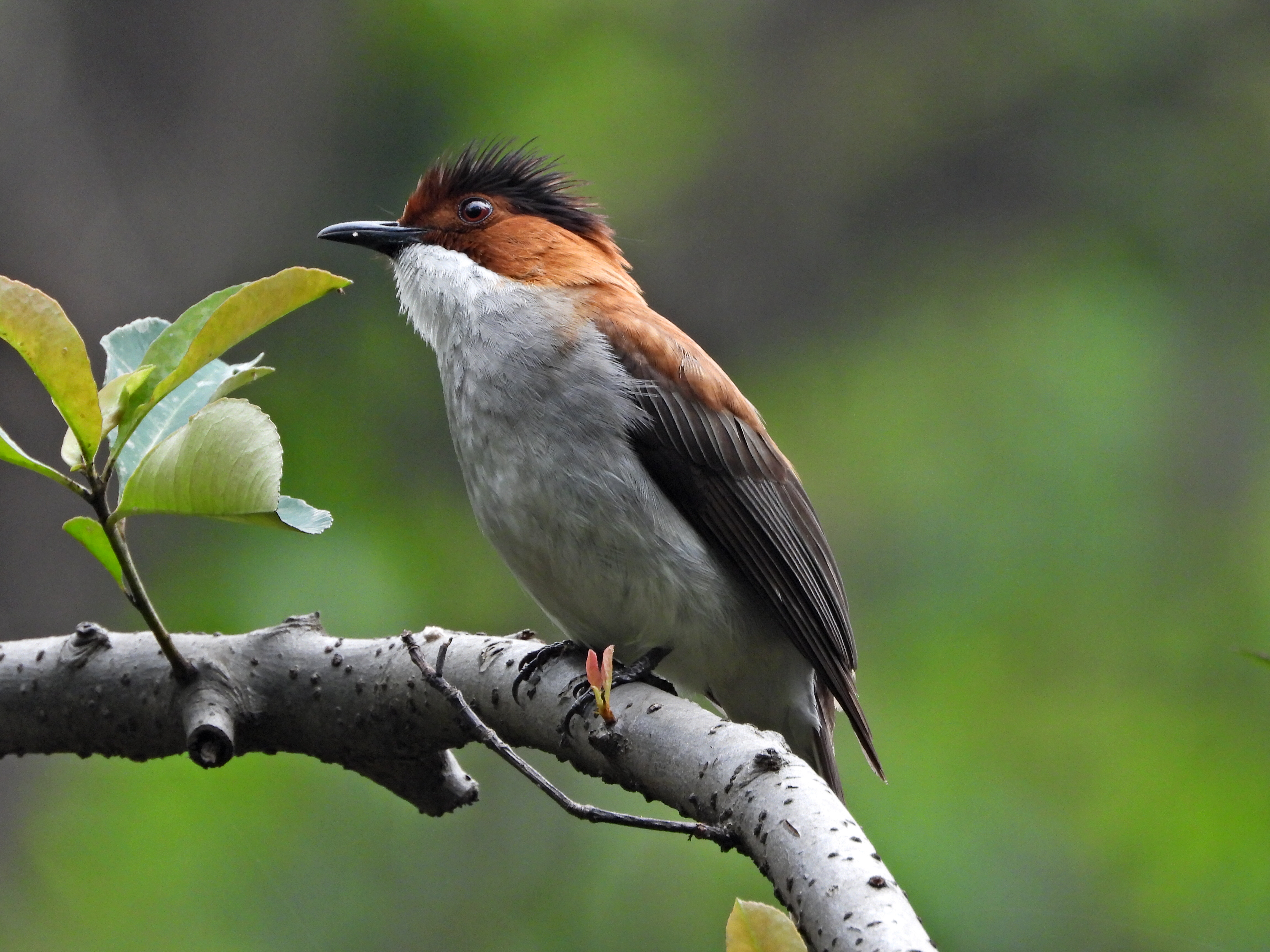
Chestnut Bulbul
Chestnut Bulbul (Hemixos castanonotus, 栗背短脚鹎).
These bulbuls are easiest to find in the forests, especially over the Winter and into the Spring, but they are more obscure in the Summer and I rarely see them in Autumn. This one has been happily singing every morning and evening by a rivulet near the bottom of Yuelu Mountain; I am fortunate enough to often hear it.

Subscribe to:
Posts (Atom)